Guide
Card sleeve sizes explained
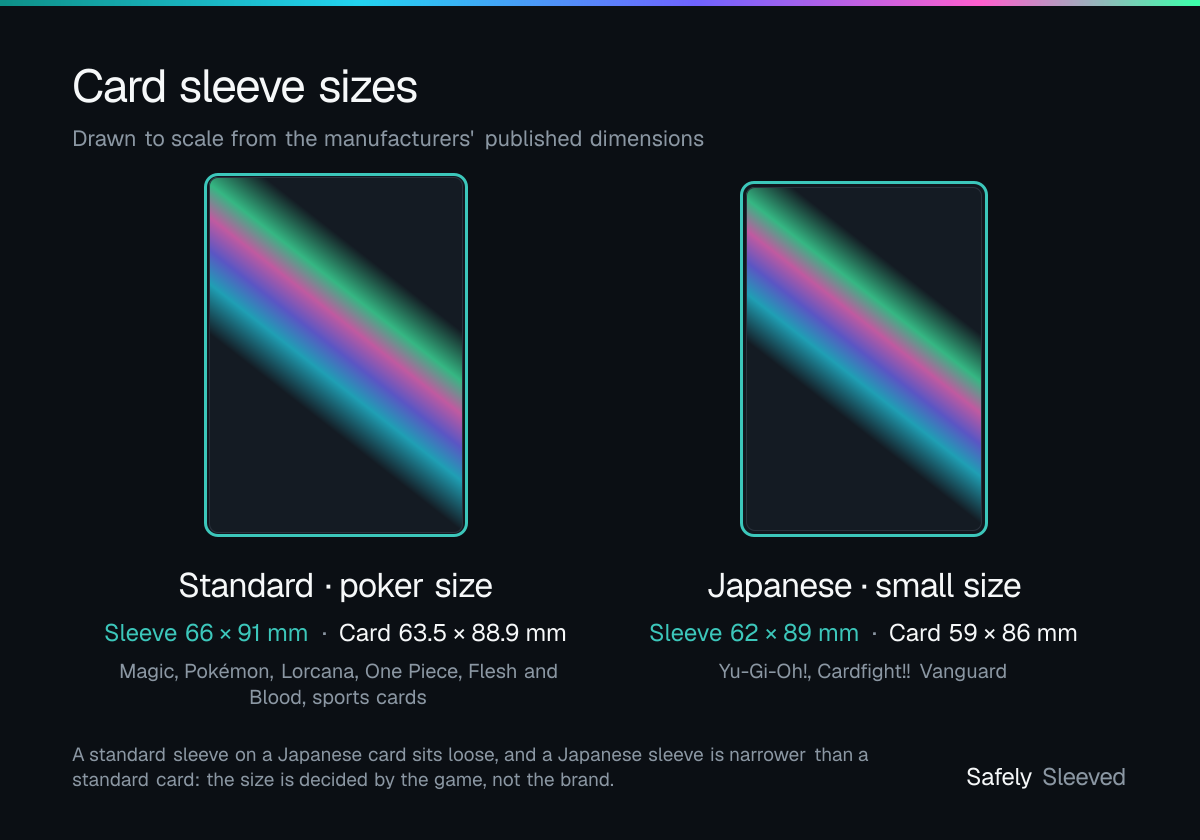
There are two sleeve sizes that matter. Standard sleeves are 66 × 91 mm and fit the 63.5 × 88.9 mm cards used by Magic, Pokémon, Lorcana, One Piece and sports cards. Japanese sleeves are 62 × 89 mm and fit the smaller 59 × 86 mm cards used by Yu-Gi-Oh! and Cardfight!! Vanguard.
Two standards, not one
Nearly every sizing mistake comes from assuming there is a single trading card size. There are two in common use, and they are different enough that a sleeve for one is visibly wrong on the other.
Standard size, sometimes called poker size, is a card of 2½ × 3½ inches, or 63.5 × 88.9 mm. Ultimate Guard's standard sleeves for these measure 66 × 91 mm, and the games listed on their own packaging are Magic: The Gathering, Pokémon, Lorcana, One Piece and Flesh and Blood.
Japanese size, also called small size, is a smaller card of roughly 59 × 86 mm. The sleeves are 62 × 89 mm, and manufacturers list Yu-Gi-Oh! and Cardfight!! Vanguard as the games that use them.
| Size | Card | Sleeve | Games |
|---|---|---|---|
| Standard (poker) | 63.5 × 88.9 mm (2½ × 3½ in) | 66 × 91 mm | Magic, Pokémon, Lorcana, One Piece, Flesh and Blood, sports cards |
| Japanese (small) | ≈59 × 86 mm | 62 × 89 mm | Yu-Gi-Oh!, Cardfight!! Vanguard |
| Inner (Perfect Fit) | 63 × 88 mm | Sized to the card; 100 µm thick version | Worn under a standard sleeve, any game |
Why the sleeve is bigger than the card
A sleeve is always a few millimetres larger than the card it holds, and that gap is deliberate. It lets the card go in without scraping the edges on the way, and it leaves room for the card to sit without pressure on its corners.
Too much gap is a problem of its own. A card that can shift inside its sleeve wears at the corners as it moves, producing the whitening the sleeve was bought to prevent. Toploader thickness matters for the same reason. Protection that does not fit ends up abrading the card.
Inner sleeves change the maths
Inner sleeves, widely known by Dragon Shield's "Perfect Fit" name, are sized close to the card itself. Their Perfect Fit inner sleeves are made for 63 × 88 mm cards and the thick version is 100 µm of polypropylene.
Used underneath a normal sleeve, they seal the card at both ends: the card goes into the inner sleeve, then into the outer sleeve from the opposite direction so neither opening is exposed.
The cost is bulk. Two layers of plastic per card measurably thickens a deck, which affects shuffling and whether the deck still fits a box rated for single-sleeved cards.
Rigid holders are sized by thickness, not by area
Once you move past sleeves, sizing switches units. Toploaders and semi-rigid holders are sold by point thickness, where one point is 0.001 inch, or 0.0254 mm.
Standard TCG cards and modern base sports cards fall in the 20–35 pt range and fit a regular toploader. Thicker stock climbs past that. Relics, patches and heavy premium cards all do, and manufacturers make holders in tiers running into the hundreds of points.
PSA's semi-rigid holders are stated to fit cards up to 2½ × 3½ inches and up to 35 points of thickness, which is the constraint that matters if you are preparing a submission.
Recommendations
What we’d buy
The mistake this page exists to prevent is buying the wrong size, so here is one sleeve for each size in the table above — the two outer sizes that fit different games, and the inner sleeve that goes underneath a standard one. Every figure below is the manufacturer’s own, which is rarer in this category than it should be.
AffiliateProduct links are Amazon affiliate links: buy through one and this site earns a commission, at no extra cost to you. They are the only paid links here — every citation earns nothing. How this site is funded
Standard size, most western TCGs
Ultimate Guard Katana Sleeves, Standard Size
66 × 91 mm is the figure this page’s table gives for standard sleeves, and Ultimate Guard states it on the product itself rather than leaving you to measure. Fits Magic, Pokémon, Lorcana, One Piece and sports cards.
- Pack
- 100 sleeves
- Sleeve size
- 66 × 91 mm
- Fits
- Standard cards, 63.5 × 88.9 mm
- Material
- Polypropylene, acid-free, no PVC
Published by Ultimate Guard
Limitation
The link goes to the clear version. Clear is fine for most play and ideal if you want the card visible, but Magic’s tournament rules require a completely opaque sleeve on double-faced cards — so if your deck runs any, buy one of the coloured backs in the same range instead.
Check price on AmazonAffiliate link
Japanese size, Yu-Gi-Oh! and Vanguard
Ultimate Guard Katana Sleeves, Japanese Size
The size people get wrong. At 62 × 89 mm these are visibly smaller than standard sleeves, and a standard sleeve on a Yu-Gi-Oh! card leaves it loose enough to slide — which is the failure this page is trying to save you from.
- Pack
- 60 sleeves
- Sleeve size
- 62 × 89 mm
- Fits
- Japanese-size cards, about 59 × 86 mm
- Material
- Polypropylene, acid-free, no PVC
Published by Ultimate Guard
Limitation
Sixty sleeves a pack against a hundred for the standard size, so the cost per card is higher — that is the format, not this product. And they do not fit standard cards: buying Japanese size for a Magic or Pokémon deck is the exact error this page is about, just in the other direction.
Check price on AmazonAffiliate link
Inner sleeve, worn under a standard
Dragon Shield Perfect Fit Thick Inner Sleeves, Standard
The third size, and the one people do not realise is a size at all. At 63 × 88 mm these are cut to the card rather than around it, so they add a layer without adding a rattle — which is what makes double-sleeving work.
- Pack
- 100 sleeves
- Sleeve size
- 63 × 88 mm
- Fits
- Standard cards, under an outer sleeve
- Material
- Polypropylene, 100 µm
Published by Dragon Shield
Limitation
Two thickness figures exist for this product. Dragon Shield’s own page says 100 µm and the Amazon listing’s thickness field says 120, and we use the manufacturer’s. The difference matters if you are working out whether a double-sleeved deck still closes in its box, because that is the real cost of double-sleeving — sixty cards each gaining two layers adds up faster than people expect.
Check price on AmazonAffiliate link
Worth knowingThe two outer sleeves are the same product in two sizes, which is the point: size is the variable, not brand. If a listing tells you a sleeve is “for Pokémon” or “for Yu-Gi-Oh!” without giving a measurement in millimetres, it is telling you about branding rather than fit — and fit is the only thing that decides whether a card is protected or rattling around. The inner sleeve is the exception that proves it: it is sized to the card instead of to the sleeve above it, which is why it is the one size you buy on purpose rather than by game.
Common questions
- What size sleeves do Pokémon cards need?
- Standard size, 66 × 91 mm. Pokémon cards are standard size regardless of the language they were printed in, so the same sleeves fit English and Japanese cards alike.
- Are Japanese Pokémon cards smaller than English ones?
- No. Manufacturers list Pokémon under standard size with no language qualifier, and their Japanese-size sleeve lines name only Yu-Gi-Oh! and Cardfight!! Vanguard. Some hobby sites repeat the claim that Japanese Pokémon cards are smaller, but sleeve makers do not treat them as a separate size.
- What size sleeves do Yu-Gi-Oh! cards need?
- Japanese size, 62 × 89 mm, for a card of roughly 59 × 86 mm. Yu-Gi-Oh! cards are smaller than Magic and Pokémon cards, so a standard 66 × 91 mm sleeve will be noticeably loose on them.
- What does 35 pt mean on a toploader?
- Point thickness. One point equals 0.001 inch (0.0254 mm), so a 35 pt holder fits a card up to 0.035 inches thick. Most standard TCG and modern base sports cards fall between 20 and 35 pt.