Guide
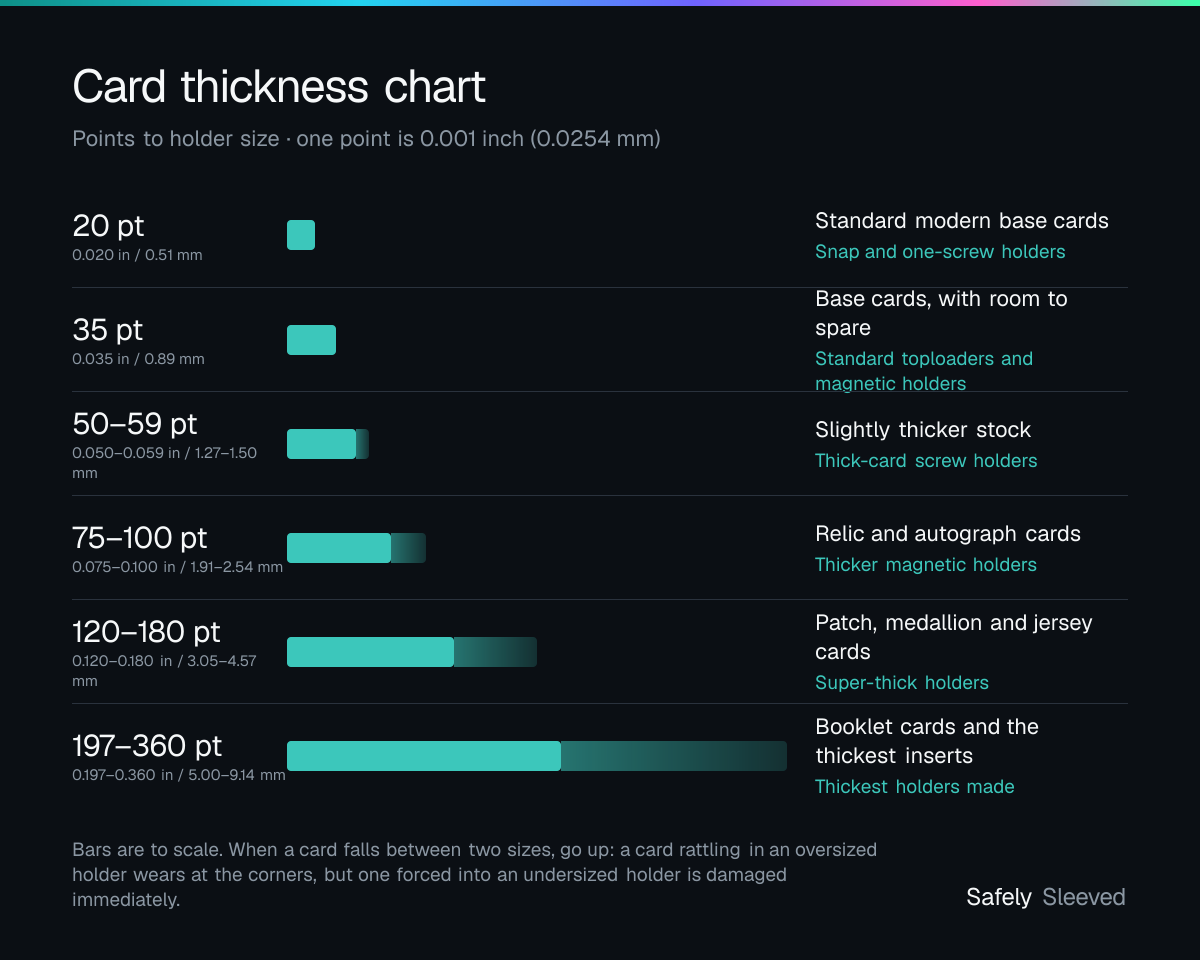
Card thickness chart: points to holder size
Card thickness is measured in points, and one point equals 0.001 inches (0.0254 mm), so a 35 pt card is 0.035 inches thick. Holders are sold by the maximum point thickness they accept: a standard modern base card is around 20 pt, a standard toploader takes up to 35 pt, and relic, patch and booklet cards climb from roughly 55 pt to 360 pt.
What a point actually is
The unit is the whole reason this is confusing, because "point" sounds like a category and is actually a length. BCW states it plainly: one point is equivalent to 0.001 inches, or 0.0254 millimetres.
So the arithmetic is trivial once you know it. A 35 pt holder accepts a card up to 0.035 inches thick. A 130 pt holder accepts 0.130 inches. The number on the packet is the card thickness in thousandths of an inch, not the holder's own thickness and not a product tier.
It also explains why the point sizes look like odd numbers: 59, 79, 108, 138. They are not arbitrary. They are the manufacturers' tooling sizes, and they cluster around common card types.
Points to holder size
The mapping below is the one that covers almost every card you will handle. When a card falls between two sizes, go up: a card rattling in an oversized holder wears at the corners, but a card forced into an undersized one is damaged immediately and permanently.
| Points | Thickness | Typical cards | Holder |
|---|---|---|---|
| 20 pt | 0.020 in / 0.51 mm | Standard modern base cards | Snap and one-screw holders |
| 35 pt | 0.035 in / 0.89 mm | Base cards, with room to spare | Standard toploaders and magnetic holders |
| 50–59 pt | 0.050–0.059 in / 1.27–1.50 mm | Slightly thicker stock | Thick-card screw holders |
| 75–100 pt | 0.075–0.100 in / 1.91–2.54 mm | Relic and autograph cards | Thicker magnetic holders |
| 120–180 pt | 0.120–0.180 in / 3.05–4.57 mm | Patch, medallion and jersey cards | Super-thick holders |
| 197–360 pt | 0.197–0.360 in / 5.00–9.14 mm | Booklet cards and the thickest inserts | Thickest holders made |
Measuring a card without a gauge
The reliable method is a printable point gauge, a card-shaped template with graduated slots that you slide the card into. Manufacturers publish these free, and they must be printed at 100% scale or the measurements are meaningless, which is the step people skip.
The rough field method uses coins as reference thicknesses. BCW's own guidance frames its larger sizes this way, so a stack of coins held beside the card gets you to the right holder without a gauge.
Digital calipers settle it outright if you own a pair. Measure in inches and multiply by 1,000: 0.032 inches is a 32 pt card, which needs a 35 pt holder.
| Points | Coin equivalent |
|---|---|
| 59 pt | One dime |
| 79 pt | One quarter |
| 108 pt | A quarter plus a dime |
| 138 pt | Two quarters |
| 197 pt | Three quarters |
| 360 pt | Five quarters |
Where the number matters most
Grading submissions are the case with consequences. Semi-rigid holders are sold by point capacity like everything else, and a thick card forced into a standard holder can be dinged on the way in, before a grader has even seen it.
Magnetic one-touch holders are the other. They close under magnetic pressure, so an over-thick card either prevents the halves seating or is compressed between them. Neither is a state you want a valuable card to sit in for years.
For binders and sleeves the number matters less, because both are flexible. It resurfaces indirectly: thick cards fill binder pockets and bow the pages, which is a capacity problem rather than a fit problem.
Recommendations
What we’d buy
The number on the packet is the card thickness the holder accepts, not the holder’s own thickness and not a quality tier. These two are the same holder in the same size from the same maker, separated only by that number — which is the distinction this page exists to make.
AffiliateProduct links are Amazon affiliate links: buy through one and this site earns a commission, at no extra cost to you. They are the only paid links here — every citation earns nothing. How this site is funded
35 pt — the default
BCW 3 × 4 Standard Topload Holders, 35 pt, 400 count
The rating that covers standard modern base cards with room to spare, bought in the quantity that makes sense once you know the number you need. This listing states 35 pt in the product name, which is not something every BCW 3 × 4 listing does.
- Pack
- 400 holders
- Holder rating
- Cards up to 35 pt
- Holder material
- Rigid PVC, containing no plasticizers or stearates
- Holder size
- 2¾ × 3⅞ in interior
Published by BCW
Limitation
Rigid PVC, which is right for transit and handling and wrong for decades of storage. BCW states these contain no plasticizers or stearates and will not migrate, which is the distinction that matters — but a card you are putting away for years belongs in polypropylene in a stable box, not in a toploader.
Check price on AmazonAffiliate link
20 pt — and the trap on this page
BCW Card Sleeve and Toploader Combo, 200 count
The same 3 × 4 holder from the same maker, rated to 20 pt rather than 35. Put beside the pick above it shows the thing this page is about: identical size, identical material, different number, and only the number decides whether a card fits.
- Pack
- 200 holders + 200 sleeves
- Holder rating
- Cards up to 20 pt
- Holder material
- Rigid PVC, containing no plasticizers or stearates
- Holder size
- 3 × 4 1/16 in exterior, 2¾ × 3⅞ in interior
Published by BCW
Limitation
Twenty points covers standard base cards and nothing thicker. A relic, patch or thick insert forced into one is how corners get dinged — which is the failure this page is written to prevent. It includes sleeves, which is the correct order anyway: card into the soft sleeve first, then into the holder.
Check price on AmazonAffiliate link
Worth knowingBCW sells 3 × 4 holders at both of these ratings under names that do not always distinguish them, and the two products are visually identical in a photograph. Read the point rating rather than the picture, and when a card falls between two sizes go up — a card rattling in an oversized holder wears at the corners slowly, while a card forced into an undersized one is damaged immediately and permanently.
Common questions
- How thick is a 35 pt card?
- 0.035 inches, or about 0.89 mm. One point equals 0.001 inches (0.0254 mm), so the point number is simply the card thickness in thousandths of an inch.
- What point size are standard trading cards?
- Standard modern base cards are around 20 pt. A standard toploader accepts up to 35 pt, which covers base cards comfortably.
- What size holder do I need for a thick card?
- Match the point rating to the card and round up. Relic and autograph cards typically need 75–100 pt, patch and jersey cards 120–180 pt, and booklet cards up to 360 pt.
- How do I measure card thickness without a gauge?
- Use a printable point gauge at 100% scale, or compare against coins: roughly a dime for 59 pt, a quarter for 79 pt, two quarters for 138 pt. Digital calipers are exact: measure in inches and multiply by 1,000.